
On today’s blog, we are going to be discussing one of Boston’s famous disasters. In the midafternoon of January 15th 1919, hot molasses flooded the streets of Boston’s North End leaving a wake of destruction. This is the Great Molasses Flood.
The North End is one of Boston’s continuous neighborhoods since colonization in 1630. Today, the North End remains a vibrant neighborhood for Italian culture. It is also one of the most visited locations due to the waterfront attractions. In the start of the 19th century, the North End was home to many immigrants with the largest group being Italians. As the community grew larger, the North End got its first commercial factory on Commercial Street, and later expanded to Fulton and Lewis streets. Towards the start of the 1840s, the North End became overcrowded. During this period of high immigration primarily from eastern Europe, many of the residents of the North End moved to more wealthy neighborhoods around the waterfront such as Beacon Hill. The North End was hit the worst during the Cholera outbreak in 1849.
After recovering from the Cholera epidemic, the North End faced another dilemma, this time with religion. Along with immigration reaching a new height in the North End, it also brought a new look at the Churches in the area. In general, Boston has had a torrid past between the Catholics and Protestants which came to a head at the Eliot School. The Eliot School, under Massachusetts law, was required to have students recite the ten commandments at the start of each day. A ten year old boy was called to recite the commandments and refused because it was from a Protestant bible. A newly arrived priest from Europe, told his Catholic congregation to refuse saying the Protestant version, because he viewed it as unholy. The same ten year old was again called to recite the commandments and again refused leading the student to be whipped. The principal of the school told the students that they would have to leave school if they did not follow the law. The Eliot School lost all the Catholic students shortly after. This incident gave way to the creation of Catholic schools.
In the later part of the 19th century, the North End was revived with the support from Town Hall. The decaying wooden structures were replaced with brick buildings, which are still standing today. Another school opened up to promote skills for residents looking for work. During the 20th century, the North End was made up of Italian and Jewish Americans. Some Italian Americans began to set up their own companies like the Prince Macaroni Company. The Company brought in stable employment for the residents and helped the revitalization project. The city of Boston created the Paul Revere Mall that allowed local businesses to make a shopping district. Along with the mall, schools, a Public bathhouse, and a branch of the Boston Public Library were added. The city also built the Civic Service House in 1901, which was a specialized school for residents to work towards citizenship and civic education.

On January 15th, 1919 around midday, residents of the North End were going about their day when many heard a loud groan. Most people thought it was the subway until the 50 foot tank of Molasses broke, unleashing more than 2 million gallons of hot and sticky substance into the North End. The tank belonged to the Purity Distilling Company and was only four years old. The Purity tank was next to the US Industrial Alcohol building in the heart of the factory sector. The bolts that held the tank ripped off like gun shots and the crude molasses rushed out. About an eight foot wave destroyed many freight cars, train beams, buildings and more as it swept through the North End.
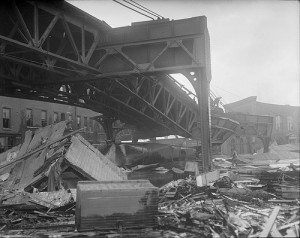
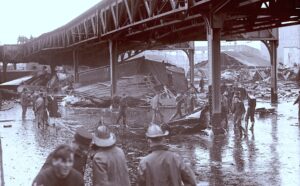
In total, 21 people died and 150 people were injured. It took weeks to clean up the molasses from the streets. Rescuers included everyone from Police to Military cadets from the USS Nantucket, as they tried to free people from the liquid. However, rescuers were fighting the cooling period as people were getting stuck as the liquid congealed around them. The majority of the victims were workers in the north end. Clean up crews used a combination of sea salt and sand to soak up the syrup. Parts of Boston Harbor were brown until the summer of 1919.
About 120 residents brought a class action lawsuit against United States Industrial Alcohol. The court case was one of the first class action suits in the state of Massachusetts and was a key factor in corporate regulation. Many residents complained about the Molasses tank before the Flood citing that the tank was already leaking. Purity Distilling, instead of fixing the problem, they painted over the tank to match the color of the liquid. Structural engineers confirmed during the trial that the tank was too thin to hold the molasses. In addition, the engineers believe that the tank walls, along with the change in temperature, started a chemical reaction causing the explosion. The lawyers for the USIAC tried to say the tank was sabotaged as a scapegoat. A state auditor determined the United States Industrial Alcohol Company was at fault. The USIAC paid one million in settlement.
To learn more
History Channel Youtube – https://www.youtube.com/watch?v=wKax9EXLZps
WVCB Boston Clip – https://www.youtube.com/watch?v=DwpG3omW7mA
City of Boston Article, The Boston Molasses Flood – https://www.boston.gov/news/100-years-ago-today-molasses-crashes-through-bostons-north-end
Boston Globe Article – https://www.bostonglobe.com/2026/01/15/newsletters/starting-point-great-molasses-flood/
Images are from, MIT Almuni Association and The Old North Church Historical Site
Recent Comments