
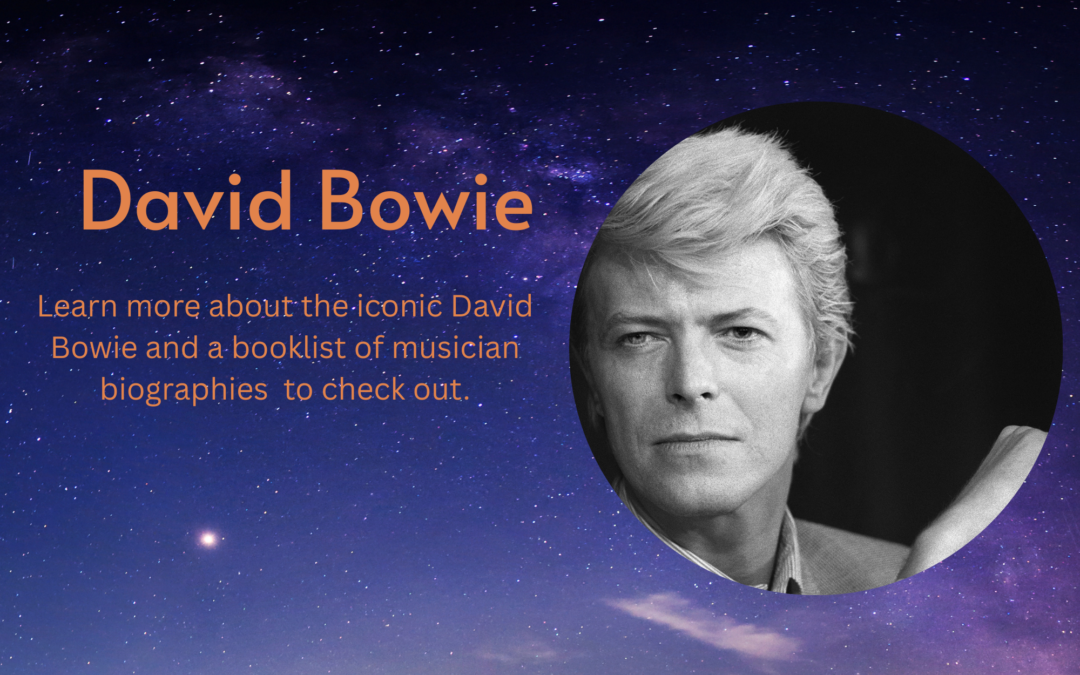
We’re kicking off the new year by looking at one of the most celebrated musicians of all time, David Bowie. In today’s post, we examine Bowie’s life and his career. We also included some book recommendations and a list of his top ten songs. If you want to go beyond Bowie, check out some of the biographies written about his friends and peers below.
Born David Robert Jones in England on January 8th, to Margaret and Haywood Jones. The family moved around London before settling in at Sundridge Park. He was noticed by his teachers for his expressive dancing. He became inspired by the sounds of the British Jazz clubs in the West End. His father was very supportive of David going into showbusiness, and took him to meet performers at the Royal Variety. When he was thirteen, he began playing with some cover and jazz bands before switching over to pop music. In 1966, he created his new stage name, David Bowie, after the pioneer James Bowie. David, alongside his manager, Kenneth Pitt, set off to pursue his career. In 1969, Bowie had his first hit song, Space Oddity. The song reached number 5 on the UK charts. Bowie’s first album, David Bowie, comprised his interests of mixed media and reflected his childhood around the West End scene.
It was during the 1970s that Bowie’s career began to take off. Hunky Dory was written after a trip to America where he later signed with RCA records. The album was composed of six demos, which Bowie wrote during his visit to America. Most of the song titles are named after iconic Americans, such as Bob Dylan and Andy Warhol. Right after Hunky Dory was released, Bowie put out his most acclaimed album, The Rise and Fall of Ziggy Stardust and the Spiders from Mars. The album marked the rebirth of Bowie as a stage performer, as he embodied the character of Ziggy Stardust. The lead single on the album is “Starman”, which many critics say was the catalyst for his future success. In 1972, he worked as a producer for Lou Reed and Iggy & The Stooges. His collaborations with Iggy led to the hit song “Let’s Dance” ,and Bowie went on to produce two more of their albums. In September of 1972, Bowie embarked on his first US tour for the Stardust album. The tour was sold out and featured costumes inspired by Japanese theater. On stage, his lead guitarist, Mick Ronson helped create an otherworldly experience for fans and to push what rock and roll could be like. When the tour finished, Bowie announced that the Stardust tour would be his last, effectively killing off his larger than life persona.
A year later in 1973, Bowie released Aladdin Sane, which was created during the American leg of the Stardust Tour. In the fall of 1973, he released Pin-Ups, a cover album with songs from his favorite artists. In 1974, he ushered in his new phase and took a dystopian style in the album, Diamond Dogs. The album had more tension in the backings which is shown on the first single “Rebel Rebel”. The album was a sharp contrast to his disco infused Stardust. Around this time, other artists were getting played on radio stations with disco records, which critics at the time said things were sounding very similar. Bowie saw this as the moment to set himself apart from his prior album. Critics and audiences were intrigued with this sharp contrast between Bowie and his peers.
Bowie’s next album, Young Americans, came out in 1975. This album brought him a hit first single on the American music charts with Fame. Fame was co-written with John Lennon at Electric Lady Studios. On the album, Bowie invited up and coming R&B singer Luther Vandross to write with him. Vandross was working for Bowie as a background vocalist before starting a solo career.
Shortly after completing the album, Bowie moved to Los Angeles. In LA, he got his first movie role as Nic Roeg in the movie, The Man Who Fell to Earth. He wrote and recorded his first album in America, Station to Station. After a while of working and living in the States, Bowie moved to Berlin. During his time in Berlin, Bowie created the Low album. Low came out in 1977 and is the first in the Berlin Trilogy. The Berlin trilogy consists of Low, Heroes and Lodger. The trilogy was written during Bowie’s residency in Berlin. Low was nothing like Bowie’s past albums. At first the new style confused both fans and critics. The only pop songs on the record are “Sound and Vision” and “Be My Wife”. The rest of side A’s music includes experimental pop styles, while side B was full of ambient music. Low was created to mimic the surrealism that was popular in Berlin. The second album in the trilogy is Heroes. Heroes was much more optimistic than Low, which went back to a mainstream pop sound. The third album is Lodger and it came out in May 1979. Lodger had a sonic sound compared to the previous albums.
In the 1980s, Bowie released Scary Monsters…and Super Creeps, with the lead single “Ashes to Ashes”. He decided not to do a tour to promote the new album, and instead started to work on other projects. In 1981 Bowie teamed up with Freddie Mercury to write “Under Pressure” for Queens’ Hot Space. He also went back into acting starring in projects, Merry Christmas Mr. Lawrence, and The Hunger. Director Paul Schrader asked him to write the theme song for his movie, Cat People. Bowie’s most recognizable role was in the 1986 cult classic, Labyrinth. Jim Henson and George Lucas wanted the character Jareth to be played with a lot of charisma. Bowie came back with a single in 1983, “Let’s Dance”, which became a global hit. The mid 80s also saw Bowie return to touring with Serious Moonlight. The tour was widely successful, cementing him as a global headliner. The tour grossed 2.5 million dollars and a concert movie was filmed on the last night of the show.
In the 2000s, Bowie had his first heart attack while performing in Germany. In 2008, Bowie appeared on Scarlett Johansson’s debut album. In 2013, he released The Next Day which debuted at number 2 on the charts. In 2016, Bowie released his final album, Blackstar on his birthday. David Bowie died of cancer on January 10, 2016.
David Bowie was one of the first recipients of MTV’s Video Vanguard honor. He was inducted to the Rock and Roll Hall of Fame in 1996. In 2006, he received the Lifetime Grammy Award. After his death in 2016, he received posthumous Grammy awards for his final album Blackstar.
Best books about David Bowie
David Bowie: A Life by Dlyan Jones
The Man who sold the World: David Bowie and the 1970s by Peter Dogget
David Bowie: The Last Interview by David Bowie
Low: Bowie’s Berlin Years by Reinhard Kleist
Moonage Daydream: The Life and Times of Ziggy Stardust by David Bowie
Spider from Mars: My Life with Bowie by Mick Woodmansey
Why Bowie Matters by Will Brooker
Rebel Rebel: The Songs of David Bowie 1963-1976 by Chris O’Leary
Bowie’s Bookshelf by John O’Connell



Biographies of David Bowie’s Peers and Collaborators
John Lennon: A Life by Philip Norman
Cher by Cher
Mercury by Lesely-Ann Jones
My Love Story by Tina Turner
Happiness becomes you a guide to changing your life for good by Tina Turner
Mick Jagger/Rolling Stones – The Stone Age by Lesely-Ann Jones
Iggy Pop: Open up and Bleed by Paul Trynka
Recent Comments