On today’s blog, we are going to cover the three composers that were featured in the opening ceremony of the Winter Olympics Milano 2026. The opening ceremony featured musical selections from Giacomo Puccini, Gioachino Rossini, and Giuseppe Verdi. Learn more about each of the composers below! We have included some song recommendations as well.
Nessun Dorma
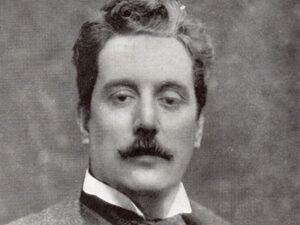
Giacomo Puccini was born on December 22, 1858 to Michele and Albina Puccini. He is widely considered to be the greatest opera composer to focus on realism. The family resided in Lucca, where the Puccini’s family served as the music directors for the San Martino Cathedral. When Giacomo was five, his father died suddenly, leaving the family to rely on a small pension. His mother was able to keep working as the organist for the Cathedral. Giacomo decided that he was going to pursue opera after seeing a performance of Verdi’s Aida in Pisa. Giacomo studied at the Milan Conservatory. Giacomo caused quite a scandal after he ran off with a married woman, Elvira Gemignani, and together had a son.
First opera – Manon Lescaut 1893
Puccini’s early period consists of three operas, Le Vili, Edgar, and Manon Lescaut. Le Vili and Edgar received praise from the Milan critics and offered commission for more. His third opera, Manon Lescaut, was inspired by the opera of the same name by Jules Massenet and from the novel by Abbe Prevost. His publisher, Ricordi, did not think it was smart for Puccini to write another Manon because of the success of the Massenet piece. Reports say Puccini wanted to write Manon “a desperate passion” Italian opera. This was the first attempt Puccini made to write the libretto alone, but he was talked into working with an established librettist to make it better. A librettist is responsible for the lyrics of the songs and the dialogue. When it premiered in 1893, it became a massive success.
Best opera – Madame Butterfly, 1904
The original version of the opera premiered in 1904 with famed soprano Rosina Storchio as the Butterfly. However, during the performance a costume mishap revealed that Storchio was pregnant which was a faux pas during that time. After the opening night and horrible reviews, Puccini reworked the opera and a revised version premiered in Brazil in late 1904. Puccini revised the opera five times before the version we still use today came out in 1907. Madame Butterfly is based on the story by John Luther Long and has three acts. The opera was the inspiration for the Broadway musical, Miss Saigon.
Last opera – Turnadot 1924
Turnadot is an opera that has three acts and is based on the play of the same name. It was written by Puccini and the librettists were Giuseppe Adami and Renato Simoni. The setting of the opera takes place in China and takes its name from the Persian word Turandokht. Puccini started working on it in 1920 after he hired Adami and Simoni, however Puccini already started writing the score without the lyrics. The score included excerpts from Chinese melodies to fit the setting of the story. One of the melodies Puccini used became a motif for the Princess Turnadot character.
Puccini was in the midst of writing Turnadot when he was diagnosed with throat cancer from a life long habit of smoking. He was sent to Brussels to undergo treatment, and he died shortly after. His funeral was held at the Saint Mary’s Royal Church in Brussels. He left Turnadot unfinished but La Scala held the performance in Puccini’s honor and Franco Alfano finished the opera based on sketches. Arturo Toscanini conducted the first performance on April 25th, 1926. Puccini’s legacy is associated with the various tones and forms of his operas. Each one has a different style, with recognizable melodies.
Music Recommendations
O Mio Babbino Caro, Nessun Dorma, and La Bohème
The Barber of Seville
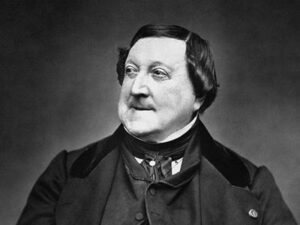
Gioachino Rossini was born in 1792 to Giuseppe and Anna Rossini. Giuseppe was a musician with his primary instrument being the trumpet. His mother worked as a seamstress to pay for vocal lessons and later became a professional singer. Throughout his early childhood, Rossini’s father was in and out of jail, leaving his mother to raise him alone for several years. Rossini credited his career to his mother, who took him with her to rehearsals around the region. The Rossini family moved to Lugo, where Gioachino had his first formal music training. When he was 12 years old, Rossini had written six sonatas, and two years later he was working with the Bologna’s Philharmonic School. His parents gave their blessings for Gioachino to move alone to Venice to pursue a career. In 1810, Rossini premiered his first opera to commercial success. His 1813 opera, Tancredi brought him international fame and was performed at opera houses in London and New York. This success allowed Rossini to take a job as a music director in Naples so he could continue to write operas. Here in Naples, he wrote one of his most famous operas’ The Barber of Seville. Gioachino and his wife Isabella were beginning to have concerns at the rise of anti-monarchy, so they decided to move to Vienna in 1822. The Rossini’s moved to Paris in 1823 and he wrote his grand orchestral score, William Tell.
After completing William Tell, Rossini retired from writing large scale pieces. During this period, he wrote several short works for solo instruments. Rossini was 37 when he retired and when he was not writing, he was focusing on his health. He had arthritis and had bouts of depression. Modern scholars think he may have had bipolar disorder. In the 1850s, Rossini saw the deaths of his wife and father, and his health deteriorated rapidly. Gioachino Rossini died at age 76 in 1868.
He is widely remembered for both The Barber of Seville and William Tell. Giuseppe Verdi was influenced by Rossini’s opera seria.
The Barber of Seville
This is the first play in the Figaro Trilogy by Pierre-Augustin Caron de Beaumarchais and is viewed as the prequel to Mozart’s Le Nozze di Figaro (The Marriage of Figaro). The Mozart opera came thirty years before, and many people were excited to see how Rossini’s opera fits in. The story focuses on the romance of the young Count Almaviva and Rosina. The Count asks his former employee, Figaro, to help him get Rosina. Rosina is annoyed that the Count lied to her throughout the show but quickly forgave him once he told how wealthy he is. The opera officially premiered in London to great reviews.
Music Remmendations
The Barber of Seville, William Tell Overture and Non Più Mesta from Cinderella
La Traviata
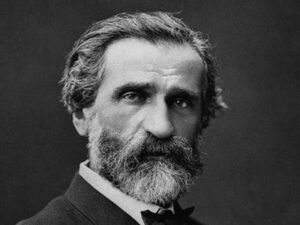
Giuseppe Verdi was born on October 10th 1813 to Carlo and Luigia Verdi. The family lived near the town of Parma and the family was close knit. He had one sister, Giuseppa, who was his best friend. Verdi was taught how to play the organ when he was six years old. His organ teacher told his parents that he was musically gifted and should have proper training. When he was eight, Verdi was the official church organist in their village. After he was done with school at the Ginnasio, he started a private studies program with Ferdinando Provesi. Provesi encouraged Verdi to audition for the Barezzi Philharmonic. Verdi soon became engaged to Antonio Barezzi’s daughter, Margherita. Verdi had dreams of going to Milan and was accepted into the Conversatory. Verdi’s father in law, Antonio Barezzi, wrote to his friend Vincenzo Lavigna who was the concert master at La Scala. In Milan, Verdi experienced highs and lows for his work. The most devastating period was in 1840 when he lost both his wife and child. This caused Verdi to go into a deep depression which can be felt in his works. While grieving the loss of his family, Verdi began to write another opera as a coping method. Nabucco was completed after a three year period. The most notable song, “Chorus of the Hebrew Slaves” (Va, pensiero, sull’ali dorate), cemented Verdi as an opera composer. The success of Nabucco allowed Verdi to stay in Milan and slowly began creating more work. On a visit to Parma, Gaetano Donizetti praised the young Verdi on Nabucco and gave Verdi the encouragement to keep composing. In the mid 1840s, Verdi began a new relationship with Giuseppina Strepponi. Verdi’s greatest period started in 1849 when he premiered Rigoletto. The opera, based on the play by Victor Hugo, Le roi s’amuse, is a thriller with the title character set on revenge for the mistreatment of his daughter. Rigoletto is one of the first operas to focus more on intensity and drama than its predecessors. This change in tone added to the opera’s success. Verdi’s middle period also saw the creation of two of his other masterpieces, Il Trovatore and La Traviata. La Traviata follows Violetta as she tries to find a real partner in Paris. The most popular song is “The Drinking Song” (Libiamo ne’ lieti calici), and is featured in the first act during one of Violetta’s famous parties.
It was around this time that Verdi started taking an interest in Italy’s politics. Many of the supporters of unification used Nabucco’s Chorus of the Hebrew Slaves as an anthem. The Milan town officials threatened anyone from singing to try and stop the growing movement. Verdi was personally asked by Giuseppe Mazzini, a nationalist leader, to create a body of work for the nationalist movement. In 1859, Naples released a statement “Viva Verdi” as an acronym for Victor Emmanuel, who would be the first King of Italy. When Italy was unified, Victor Emmanuel and Verdi met in Turin. Shortly after, Verdi stopped being heavily involved in politics.
Verdi’s last period consisted of Shakespeare adaptations. His first Shakespeare opera was Macbeth, followed by Othello (Otello) and Falstaff. Otello is Verdi’s penultimate opera. Verdi was a fan of Shakespeare’s works but he felt that he was ready to retire. Verdi agreed to work on Otello after several of his collaborators kept bothering him. The roles of Desdemona, Otello and Iago are some of the hardest characters Verdi ever wrote. By the time Otello was completed, Verdi had opera houses around Europe asking when they could stage his new work. Verdi’s last opera, Falstaff, which is a combination of the character from The Merry Wives of Windsor and Henry IV. He is quoted as saying “I have the right to laugh a little” after a career long of intense and serious dramas. The premiere of Falstaff at La Scala drove the ticket prices up for the first time in the theater’s history.
Giuseppe Verdi suffered a stroke on January 21 1901, and died on January 27, 1901 at the age of 87. When the news of his death spread around Italy, all Italians came together to sing once again Nabucco’s Chorus of the Hebrew Slaves.
La Traviata, 1853
One of his most beloved works, La Traviata was written by Verdi and the libretto by Francesco Maria Piave. The opera is based on the play, La Dame aux camelias by Alexandre Dumas. La Traviata is cited as one of the easiest operas to get into. The opera is featured in the 1990 film, Pretty Woman as the filmmakers are said to have been inspired by the Verdi story.
Otello, 1887
He started writing Otello in his early sixties and is the first of Verdi’s Shakespeare adaptations. Verdi was considering retiring when his publisher encouraged him to keep writing.
Music Recommendations
Requiem, La Traviata and Rigoletto
Read More
Atlanta Opera – Giacomo Puccini – Read Here
The Metropolitan Opera, Puccini – Watch Here
Why Puccini’s Irresistible Melodies Brings Us to Tears, New York Times November 30, 2024, Read Here
English National Opera – Gioachino Rossini – Read Here
Classical FM – Gioachino Rossini: A Life, Read Here
Dallas Symphony – Giuseppe Verdi – Read Here
Opera Philadelphia – Giuseppe Verdi – Read Here
Recent Comments