
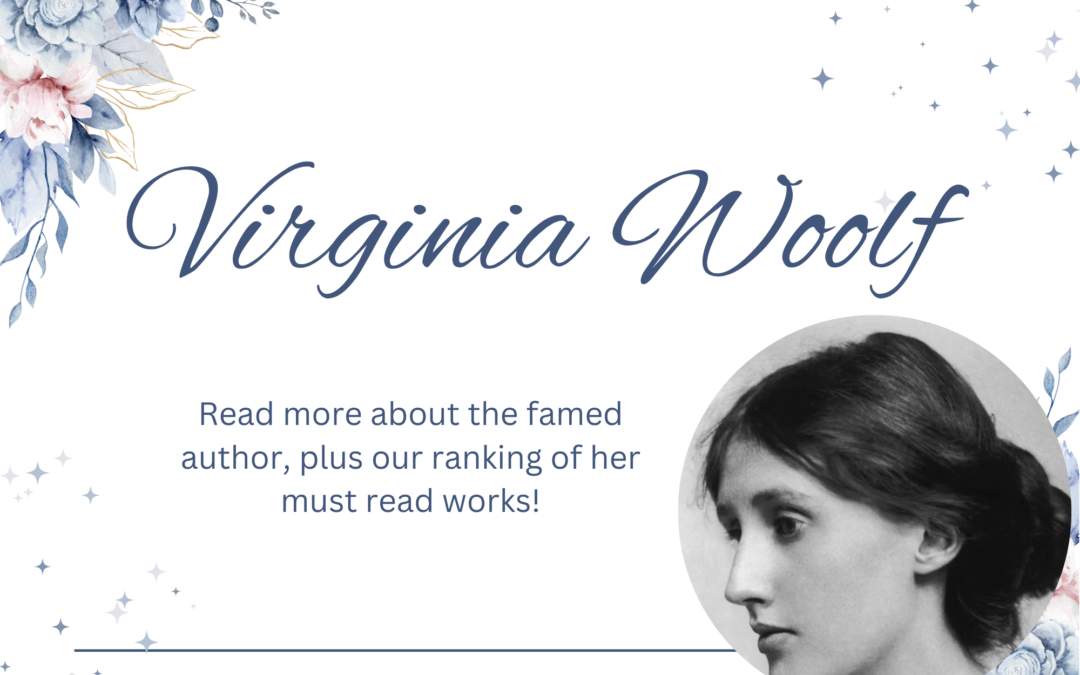
On today’s blog, we are looking at the life and career of British author, Virginia Woolf. Learn more about her unique writing style and much more! We’ve also included a booklist of Woolf’s must read works.
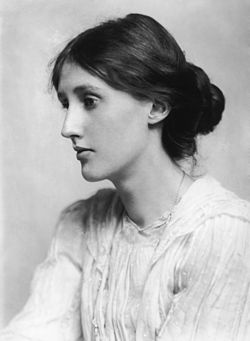
Born Adeline Virginia Stephen on January 25th 1882 in London. Her father, Leslie, was a writer and historian, while her mother, Julia, was a philanthropist. One of Virginia’s aunts was Lady Henry Somerset, a women’s rights activist. After her aunt Adeline passed, she dropped her first name and started going by Virginia. Both of her parents had children from prior relationships, so the family was quite large. Leslie was married to Minny Thackeray, who was the daughter of William Makepeace Thackeray. Together Leslie and Julia had four children: Vanessa, Thoby, Virginia and Adrian.
Virginia started writing at a very young age; learning from her father, the two had a very strong bond. She started to keep a journal in 1897, which she kept up until her death. The family would rent a home in St. Ives, Cornwall with a view of the Porthminster Bay and the Lighthouse. Virginia would always reflect on the summers as some of the happiest points in her life. When she became more serious with her writings, she would use the Talland House as inspiration. The house appears in Jacob’s Room, To the Lighthouse and The Waves. The family’s last summer was in 1894, because the following year, her mother would pass.
After Julia passed, Virginia had her first mental health episode. Virginia’s half sister, Stella Duckworth, became a surrogate mother figure to the young Woolf siblings. In 1987 as Stella was celebrating her honeymoon she passed. It then fell on Stella’s husband, George, to take over the head of household; as such he launched Virginia and Vanessa into London society. Unfortunately, in February of 1904, her father, Leslie Stephens died; which causes Virginia to suffer a great mental breakdown
Probably her most well known affiliation is with The Bloomsbury Group. The Group was filled with writers, intellectuals, philosophers and artists in the 20th century. Besides Woolf, other key figures included E.M. Forester, Vanessa Bell and Roger Fry. Originally started as an all male group of students who went to Cambridge University, but it grew to include women; Virginia and her sister Vanessa were invited to join by their brother Adrian who was friends with members of the group. They would all meet in their homes in the Bloomsbury district of London (West Central 1). She would eventually marry her fellow groupmate, Leonard Woolf.
In 1908, Woolf began writing her first book, The Voyage Out. It was officially published in 1915. In 1910, Woolf’s father suddenly passed away and caused a massive depressive episode. Once she felt like she was feeling better, the book was released. The Voyage Out follows Rachel Vinrace as she sets sail for South America and goes on a coming of age journey. The book also introduces us to Mrs. Clarissa Dalloway. A few years later in 1925, Woolf published one of her most acclaimed novels, Mrs. Dalloway. Drawing parallels with her life in the upper class of British society and her mental health, the story weaves together mundane duties like going to buy flowers to the shell shock war veteran trying to readjust. The novel also shows us her unique style of writing. Woolf worked in the style known as stream of consciousness. This method was created by Dorothy Richardson, who wanted to write in a non linear mode, in order for the characters to feel less stoic and more realistic. Stream of consciousness writing mimics the unfiltered non-linear flow of human thought, capturing a character’s internal, often chaotic monologue, emotions and sensory perceptions rather than a structured narrative. Basically, you just keep writing without pausing to edit, ignoring punctuation, spelling and grammar. Scholars believe it helps to focus on the flow of the story and it’s supposed to be the rawest form of human consciousness to provide deep insight into characters.
In 1927, Woolf releases what is widely considered to be her masterpiece. To the Lighthouse is inspired from the Summer vacations the family enjoyed at Talland House in Cornwall. The novel follows the Ramsey family over the course of ten years. It is broken into three distinctive parts, The Window, Time Passes and The Lighthouse. In the Time Passes section, the narration is told from the point of view from the Ramsey house. The story centers around Mr. and Mrs. Ramsey and a family friend Lily Briscoe. Through the interactions of Mrs. Ramsey and Lily, Woolf critics the social norms of women with Mrs. Ramsey believing that wife and motherhood are the only things that should be important to a woman. Lily on the other hand, wants to pursue her art and live a more independent life.
Mental Health
One apsect of Virginia Woolf that is heavily studied is her mental health. Some believe Woolf was bipolar, others believe she could have been autisic, but nothing has been confirmed. She had her first mental health crisis when her mother died; as family members said that this is when she started experiencing severe mood swings. If we look at this through a modern lense, its very normal to have mood swings when someone is grieving. Prominent literature critique, Hermione Lee believes that Woolf was always sick during her childhood which could have been interpreted as a mental health episode. When her father died in 1904, she flung herself out of a window before collapsing. Her siblings put her in an institution to get better. At the institution, she was treated under Doctor George Savage, who prescribed her to live in a women’s home for nervousness, which didn’t help. Virginia wrote to her sister Vanessa frequently about how much she hated living in the home.
While at the wellness home she contemplate suicide. This is the first time she wrote it down, so it is documented. In a letter to Vanessa, she wrote that she would throw herself out a window again. In 1913, she attempted suicide by overdosing on veronal which nearly killed her. In 1915, she was feeling much better.
Death and final year
After completing the manuscript for her last novel/unfinished work, Between the Acts in 1941, Woolf fell into a deep depressive episode. External feelings about World War II, losing her home in the Blitz and some negative reviews she was unable to work. When her husband, Leonard, enlisted in the army, she criticized him. On March 28 in 1941, Woolf filled her pockets with rocks and drowned in the River Ouse.
Legacy
Declined in popularity after the Second World War but the feminist literature movement in the 70s helped revitalize her.
What to read by Virginia Woolf
Mrs. Dalloway
To the Lighthouse
Orlando
A Room of One’s Own
Waves
Recent Comments